
If you are just getting started, be sure to read Part 1: What Generalization in ABA Therapy Is and Why It Matters.
In Part 1, we covered what generalization means and the difference between stimulus and response generalization. Now, let’s look at how ABA therapy actively builds these skills and how you can support them at home.
How ABA Therapy Promotes Generalization
One of the most important things families should know is this:
Generalization does not happen by accident. It must be intentionally programmed and planned.
In ABA therapy, we do not assume a skill will automatically transfer to home, school, or the community. Instead, Board Certified Behavior Analysts actively design treatment plans to promote both stimulus and response generalization from the beginning.
We do this by:
- Teaching with many examples of a concept
- Practicing skills across different people
- Embedding skills in various situations
- Teaching in multiple locations
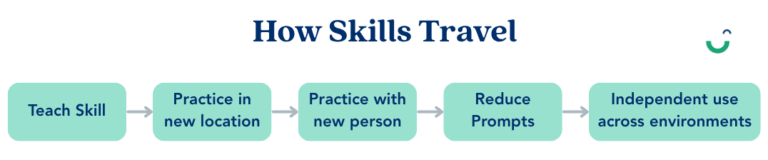
The goal is to help skills travel beyond the therapy room.
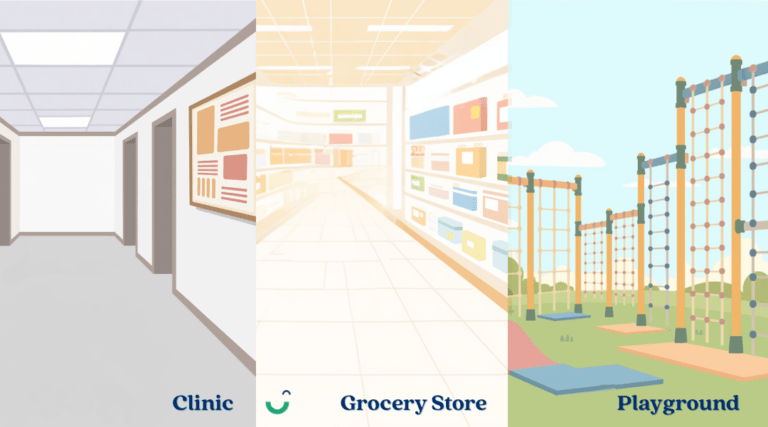
1. Teaching Across Multiple Settings
To support stimulus generalization, skills are practiced in more than one environment.
This may include:
- Therapy rooms
- Home environments
- School settings
- Community locations such as parks or stores
For example, if a child learns to say “I need a break” in session, the therapy team will intentionally practice that same skill in other environments so it becomes functional everywhere.
When the setting changes but the skill remains consistent, generalization strengthens.
2. Teaching with Multiple Examples
If a child is learning a concept, we do not teach just one example.
For instance:
- When teaching the concept of “dog,” we use examples that represent sizes and colors, in pictures and sometimes the real animal.
- When teaching greetings, we practice with different words, tones, people, and gestures.
- When teaching requests for help, we model variations like “Help,” “Can you help me?” and “I need help with this.”
This approach increases the likelihood that the child will recognize the concept in new or less familiar situations.

3. Involving Parents and Caregivers
Parents are essential for generalization.
When caregivers learn:
- How to use natural opportunities for teaching
- How and when to prompt a target response
- When to reinforce a target response
- How to model flexible language
Skills begin to appear outside of therapy much faster. This also helps the skills maintain in contexts that are more familiar, functional, and natural for the learner.
Consistency across adults helps children understand that the skill works everywhere, not just with one therapist.
4. Varying Materials and Instructions
If a child only learns a skill using one set of flashcards or one exact phrase, generalization may stall.
To prevent this, therapists:
- Rotate materials
- Change wording slightly
- Introduce different examples
- Fade prompts gradually
This promotes flexibility instead of memorization.
5. Using Natural Environment Teaching
Highly structured instruction has value and is often a first step in keeping out distractions that may interfere with learning, but the ultimate goal is to transfer skills to a more natural context in a systematic way. Generalization is strengthened when skills are practiced or taught during real-life activities. Some ways this can be done include:
- Playtime
- Mealtime
- Bedtime routines
- Community outings
- Social interactions
When learning happens within daily routines, it becomes more meaningful and more likely to transfer to natural contexts.
Signs a Skill is Generalizing (and What Can Get in the Way)
Parents often ask how to know if generalization is happening.
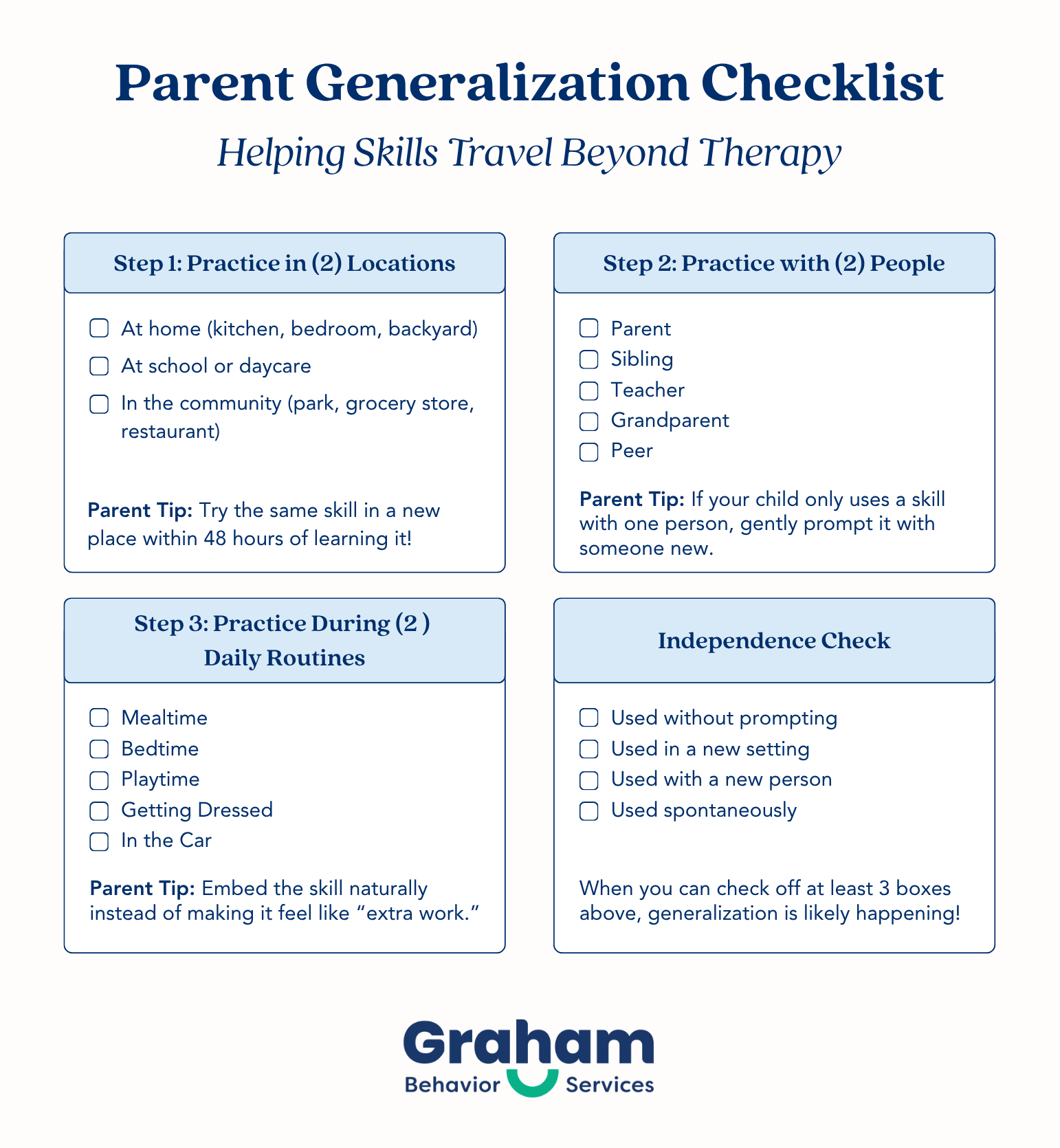
Positive signs include:
- Your child uses the skill without prompting
- The skill appears in new places
- Other caregivers report seeing it
- The skill happens naturally during daily routines
- Your child adapts the skill slightly to fit the situation
You may even hear a teacher say:
“We didn’t know you were working on that, but we’ve been seeing it.”
That is generalization in action.
However, sometimes a skill may seem “stuck” in therapy. This can happen when:
- Practice only occurs in one environment
- Prompts are not faded gradually
- Reinforcement differs across settings
- Caregivers are unsure how to support the skill
The good news is these challenges can be addressed with intentional planning and collaboration.
How Parents Can Support Generalization at Home
You don’t need to be a behavior analyst to help skills carry over.
Here are simple ways to support generalization:
1. Communicate with your BCBA
Ask:
- Where and when is this skill being practiced?
- What response is being reinforced?
- How can I practice this at home?
2. Practice During Real Routines
Embed skills into everyday moments like:
- Play
- Mealtime
- Bedtime
- Community outings
3. Stay Consistent With Language
Use the same phrases your child is learning to avoid confusion.
4. Reinforce Independent Use
Celebrate when the skill happens naturally to strengthen it.
Frequently Asked Questions about Generalization
How long does generalization take?
It varies depending on the learner, the complexity of the skill, and how often it is practiced across environments.
Is generalization automatic?
No. It must be intentionally programmed and supported.
Does generalization mean the skill is mastered?
Generalization is a strong indicator of mastery, but ongoing practice ensures maintenance over time.
Why Generalization Is the True Goal of ABA Therapy
ABA therapy is not about memorizing responses. It is about creating meaningful, lasting change.
When skills truly generalize:
- They carry over across different places, people, and situations
- Independence increases
- Behavior challenges decrease
Generalization is what turns progress in therapy into real-life success.
If you’re looking for support in building skills that truly carry over, we’re here to help.
👉 Contact us today to learn more about our services and how we support your child’s growth
Research Sources
Baer, D. M., Wolf, M. M., & Risley, T. R. (1968)
Some current dimensions of applied behavior analysis
https://onlinelibrary.wiley.com/doi/10.1901/jaba.1968.1-91
Stokes, T. F., & Baer, D. M. (1977)
An implicit technology of generalization
https://onlinelibrary.wiley.com/doi/10.1901/jaba.1977.10-349
Cooper, J. O., Heron, T. E., & Heward, W. L. (2020)
Applied Behavior Analysis (3rd ed.)
https://www.pearson.com/en-us/subject-catalog/p/applied-behavior-analysis/P200000003479
(Note: This is a textbook, so full access may require purchase or login.)
National Autism Center (2015)
National Standards Project, Phase 2
https://www.nationalautismcenter.org/national-standards-project/phase-2/
Schreibman, L. et al. (2015)
Naturalistic Developmental Behavioral Interventions
https://link.springer.com/article/10.1007/s10803-015-2407-8