
We’ve all been there: the cookie aisle showdown at the grocery store, the meltdown when it’s time to leave the playground, the resistance to an unwanted haircut. Big emotions are a normal part of childhood, and learning to handle them takes practice. For children with autism spectrum disorder (ASD), a condition that affects communication, social interaction, and sensory processing, these moments can feel even more intense. A coping skills toolkit gives your child a set of go-to strategies they can use, at home or on the go, before those big feelings take over.
What Is a Coping Skills Toolkit?
A coping skills toolkit is a collection of strategies, items, and activities that help a child calm down, refocus, or self-regulate (manage their own emotional state) during moments of stress or sensory overload (when the brain receives more sensory input, like noise or light, than it can comfortably process). The toolkit is built around your child’s individual preferences, so it works for their specific needs rather than a one-size-fits-all approach.
Why Naming Emotions Comes Before Coping Skills
Before your child can manage a feeling, they need to be able to name it. All emotions, including anger, frustration, and sadness, give kids important information about what’s happening around them. Helping your child build a vocabulary for their feelings is the foundation that makes coping strategies effective.
If your child is still learning to identify and label emotions, our post on teaching empathy and social skills offers a starting point. Once a child can consistently name what they’re feeling, they’re ready to start practicing coping strategies to manage it.
How to Build Your Child’s Coping Skills Toolkit
Building a toolkit works best as a gradual, practiced process rather than something introduced in the middle of a meltdown.
- Start with the basics. Deep breathing, grounding exercises using the five senses, or squeezing a stress ball are all good starting points. Our 5-4-3-2-1 Grounding Technique guide walks through one sensory-based option in detail.
- Practice during calm moments. Skills taught for the first time in the middle of a meltdown rarely stick. Introduce and rehearse each strategy when your child is relaxed.
- Model the skill first. Show your child what the strategy looks like before asking them to try it.
- Use role-play. Try a scenario like, “Let’s pretend your favorite show isn’t on. How would that feel? What could you do instead of yelling?” Once your child can use the strategy on their own during role-play, add it to the toolkit.
- Share your own experiences. Talking about times you’ve felt big emotions, and what helped, shows your child that everyone, including adults, needs strategies to manage feelings.
As your child gets more comfortable identifying emotions and using strategies during role-play, you can build on that foundation with visual supports and perspective-taking tools, covered below.
Coping Tools to Include, by Category
Every toolkit looks a little different. Here are some ideas to get started, organized by category.
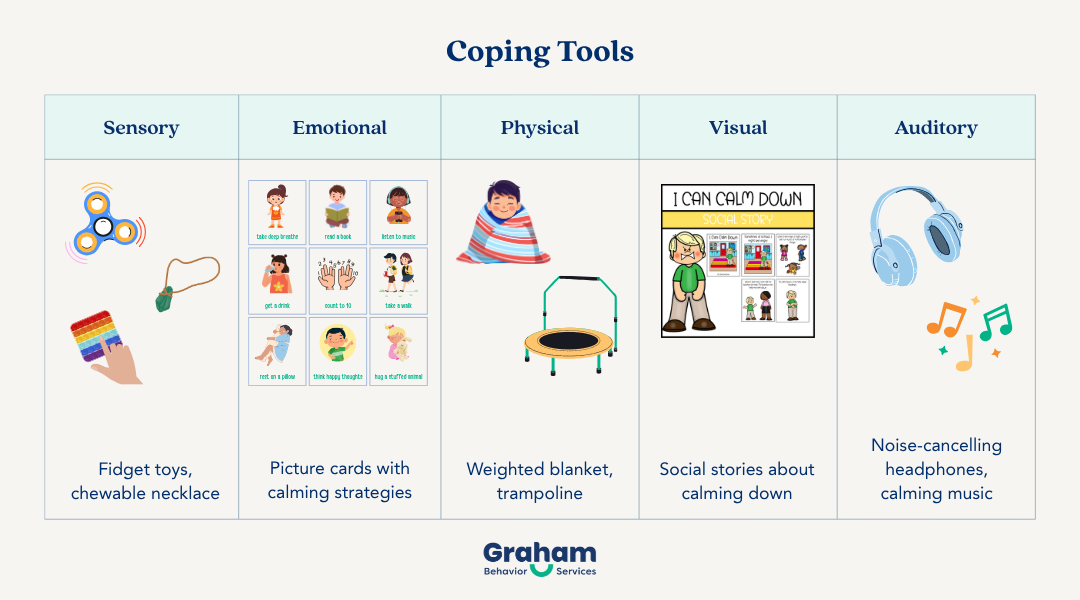
Visual supports, like picture cards and social stories, are considered an evidence-based strategy for teaching new skills to children with ASD because they provide a consistent cue that doesn’t rely on spoken language in the moment.
Teaching Kids to Gauge How Big a Feeling Is
Once your child has some strategies in place, you can help them build perspective on emotional intensity.
- Use a 1 to 10 emotion scale. Ask your child to rate how strong a feeling is. This builds awareness of intensity over time.
- Try the “will it matter?” question. Walk through it together: Will this matter in a minute? A day? A week? A year?
- Make comparisons. Help your child see the difference between everyday setbacks and bigger problems. For example: losing a board game with a sibling is not the same as a major disappointment.
These tools support emotional regulation in the moment and help build longer-term perspective and resilience.
Making the Toolkit Part of Everyday Life
A toolkit only helps if it’s used consistently. A few tips:
- Keep it accessible. Store toolkit items in the places your child spends time: at home, at school, or in the car.
- Model its use. Let your child see you reach for your own coping strategies when you’re stressed.
- Loop in teachers and caregivers. Share the toolkit with the other adults in your child’s life so strategies stay consistent across settings.
It’s also worth knowing that a strategy that works well one week may stop working the next. That’s normal, and it’s exactly why a toolkit holds more than one option. If a tool stops helping, guide your child toward trying another one rather than assuming the toolkit itself has failed.
If you’re looking for more structured, one-on-one support building routines like this, Purposeful Parenting pairs coaching with behavioral science to help New Jersey families build strategies like these at home.
FAQ
What age should a child be to start using a coping skills toolkit? Many families start introducing simple coping strategies, like deep breathing or picture cards, as early as toddlerhood. The specific tools should match your child’s developmental level.
What if my child refuses to use their toolkit during a meltdown? This is common. Once a child is already dysregulated, it’s often too late to introduce a new tool. Focus on practicing strategies during calm moments so they become more automatic over time.
Are coping skills toolkits only for children with autism? No. Every child benefits from having a set of strategies to manage big emotions. Children with ASD or sensory processing differences may need more structured, visual tools, but the approach works for neurotypical children too.
How many tools should be in the toolkit? There’s no set number. Start with two or three strategies your child responds well to, and add more over time as needed.
Where should we keep the toolkit? Anywhere your child spends regular time: a small bag at home, a folder at school, or a pouch in the car works well.
Sources
- Mazefsky, C. A., Herrington, J., Siegel, M., Scarpa, A., Maddox, B., Scahill, L., & White, S. W. (2013). The role of emotion regulation in autism spectrum disorder. Journal of the American Academy of Child & Adolescent Psychiatry, 52(7), 679–688. PubMed
- Association for Science in Autism Treatment. Simple evidence-based strategies for teaching emotion regulation. asatonline.org